The house rules of the kitchen lab
Science at home has three rules. One: predict first — before every experiment, everyone guesses aloud or draws what will happen; a wrong prediction is a golden moment, not a failure. Two: the child does it — pour, mix, measure, drop; hands on, grown-up as safety officer and narrator. Three: repeat — real scientists run trials, and children naturally want to anyway. Keep a cheap notebook as the “lab journal”: one page per experiment for the prediction, the drawing, the verdict. That habit, more than any single experiment, is what our learning through play guide celebrates.
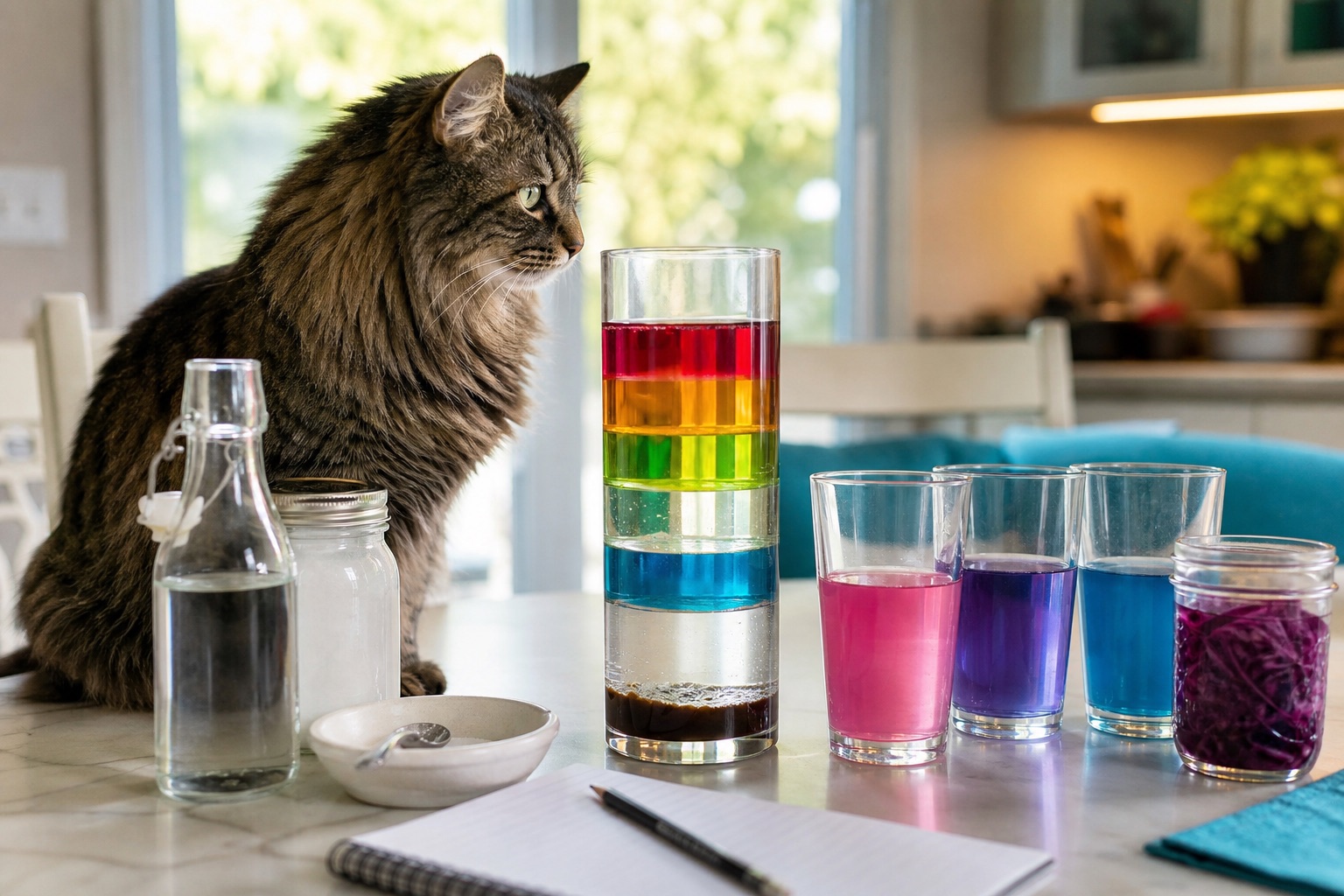
The color-changing cabbage
You need: red cabbage, hot water (grown-up job), clear cups, vinegar, baking soda · ages 5+ · smell: authentic
Steep chopped red cabbage in hot water to make a purple indicator liquid. Pour into three cups: leave one alone, add vinegar to the second (it turns pink), stir baking soda into the third (it turns blue-green). Acids and bases, revealed by a vegetable. Extend it: test lemon juice, soap water, fizzy drinks. The cabbage smell fades; the memory doesn’t.
Density tower
You need: a tall clear glass, honey, dish soap, water, oil, small objects · ages 4+
Pour honey, then soap, then colored water, then oil — each layer floats on the last. Now drop in suspects: a grape, a popcorn kernel, a bead, a bottle cap, a piece of pasta. Each finds its own level. Liquids stack like invisible floors, and “heavy for its size” becomes a sentence a five-year-old owns forever.
The great raisin race
You need: a clear glass, fizzy water, raisins · ages 3+
Drop raisins into a glass of clear fizzy drink: bubbles collect on their wrinkled skins, lift them to the surface, pop, and the raisins sink again — a slow-motion diving race that runs for twenty minutes. Ask why. Theories are allowed to be wrong; that’s what theories are for. A first cousin of the sinking-orange question (peeled versus unpeeled) is a classic from school-age experiments.
Invisible ink
You need: lemon juice, a cotton bud, paper, a lamp or warm radiator · grown-up for the heat · ages 5+
Write a secret message in lemon juice, let it dry to nothing, then warm the paper carefully and watch the words bloom brown. Oxidation, plus every spy story ever told. Science and dramatic play in one — send coded messages across the house and back.
Float the foil boat
You need: aluminum foil, a basin of water, pennies · ages 4+
Shape foil into boats and load them with pennies until they sink. Count the cargo, redesign the hull, count again. Surface tension and displacement, learned one penny at a time. The water-play instinct starts much younger — see the toddler water games — and here it graduates into engineering.
Volcano, honestly labeled
You need: baking soda, vinegar, dish soap, red food coloring, a tray · ages 3+
The classic, with an honest label: this is chemistry (acid + base = gas), not geology. Build the cone from salt dough (recipe in arts and crafts), then erupt away on a tray. Ask the question nobody asks: what happens if you double the vinegar? Change one thing at a time — that single habit is the whole method.
Shadow clock
You need: chalk or paper, a toy, a sunny window, hourly check-ins · ages 5+
Stand a figure on paper by a sunny window and trace its shadow every hour. The shadow clock drawn by your own hand makes the Earth’s rotation visible from a windowsill. Pairs beautifully with shadow theater from the rainy-day kit — same physics, different mood.
Magnetic treasure hunt
You need: a fridge magnet, a basket of household objects · ages 3+
Predict which objects will stick, sort into “yes” and “no” piles, then test. The surprise items — a coin that doesn’t, a tin that does — spark the best questions. Hunt the house for magnetic surfaces and draw a map of finds.
Grown-up tip: resist explaining too fast. “Why do you think it floated?” asked with genuine curiosity teaches more than the correct answer delivered instantly. If neither of you knows — wonderful; say “let’s find out”, and model exactly what scientists do. Safety line for everything above: tasting is off the menu, warm things stay grown-up jobs, and wash hands after the lab closes.
From kitchen to garden
The best follow-up to indoor labs is outdoor observation: puddle depth surveys and sink-or-float nature tests live in our outdoor games guide, and the observation habit connects straight back to non-fiction reading — a fact-book about sharks after a floating experiment is how curiosity compounds.